

Appearance
Mustard Color Code: HEX Code & RGB Code Values
Looking for specific mustard color code? Get exact mustard hex code #FFDB58 and mustard RGB code rgb(255,219,88). Complete color information for design and development projects featuring this rich, spicy color.
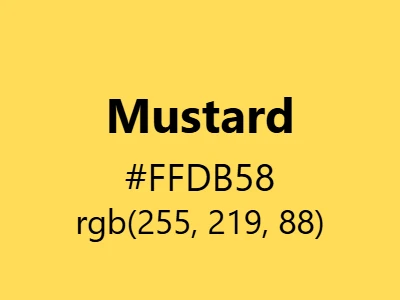
HEX
#FFDB58RGB
rgb(255,219,88)Shades of Mustard
Create custom shades of mustard with our color generator. Adjust hues, tints, and tones to find the perfect shade of mustard for your project.
Shades (Adding Black)
- FFDB58rgb(255, 219, 88)
- D0B34Argb(208, 179, 74)
- A38C3Drgb(163, 140, 61)
- 78672Frgb(120, 103, 47)
- 504522rgb(80, 69, 34)
- 2A2515rgb(42, 37, 21)
- 000000rgb(0, 0, 0)
Tints (Adding White)
- FFDB58rgb(255, 219, 88)
- FFE27Argb(255, 226, 122)
- FFE898rgb(255, 232, 152)
- FFEEB4rgb(255, 238, 180)
- FFF4CErgb(255, 244, 206)
- FFF9E7rgb(255, 249, 231)
- FFFFFFrgb(255, 255, 255)
Tones (Adding Gray)
- FFDB58rgb(255, 219, 88)
- FDDB6Argb(253, 219, 106)
- FADB7Frgb(250, 219, 127)
- F5DC95rgb(245, 220, 149)
- EFDCADrgb(239, 220, 173)
- E7DDC5rgb(231, 221, 197)
- 808080rgb(128, 128, 128)
Mustard Palette
Explore curated and automatically generated color palettes featuring mustard. See how it harmonizes with other colors for UI themes, graphics, and branding materials.
Sequential
Single hue gradient for data visualization
7 colors
Lightest
#FFFADF
Light
#FFEFB3
Medium Light
#FFE587
Medium
#FFDB58
Medium Dark
#D7B540
Dark
#B09028
Darkest
#8A6D10
Diverging
Dual hue gradient with a neutral midpoint
9 colors
Base End
#FFDB58
Left Dark
#FFE182
Left Medium
#FFE8A9
Left Light
#FCEECF
Neutral
#F5F5F5
Right Light
#D6D5F9
Right Medium
#B3B6FB
Right Dark
#8C98FE
Complementary End
#587CFF
Monochromatic
Same hue, different brightness/saturation
5 colors
Lightest
#FFFFFF
Light
#FFECAE
Medium
#FFDB58
Dark
#7D6700
Darkest
#000000
Analogous
Colors adjacent on the color wheel (30° apart)
5 colors
Left Adjacent 2
#FF587C
Left Adjacent 1
#FF8758
Main
#FFDB58
Right Adjacent 1
#D0FF58
Right Adjacent 2
#7CFF58
Complementary
Colors opposite on the color wheel (180° apart)
2 colors
Main
#FFDB58
Complementary
#587CFF
Triadic
Evenly spaced around the color wheel (120° apart)
3 colors
Main
#FFDB58
Secondary
#58FFDB
Tertiary
#DB58FF
Square
Four colors evenly spaced (90° apart)
4 colors
Main
#FFDB58
Right 90°
#58FF88
Complementary
#587CFF
Left 90°
#FF58D0
Tetradic
Two pairs of complementary colors
4 colors
Main
#FFDB58
Secondary
#7CFF58
Complementary
#587CFF
Complementary Secondary
#DB58FF
Split Complementary
Complementary colors ±30°
3 colors
Main
#FFDB58
Split Left
#58D0FF
Split Right
#8758FF
Cyclic
Circular gradient for periodic data
8 colors
0°
#FFDB58
45°
#A6FF58
90°
#58FF88
135°
#58F9FF
180°
#587CFF
225°
#B158FF
270°
#FF58D0
315°
#FF5E58
Pastel
Soft, desaturated colors for modern UI
6 colors
Light Pastel
#C9C09C
Pastel 1
#D1C8A9
Pastel 2
#D8D0B6
Pastel 3
#DFD9C3
Pastel 4
#E6E1D1
Deep Pastel
#EDEADE
Common Yellow Color Codes (HEX & RGB)
Shades of Gold →
HEX:#FFD700
RGB:rgb(255, 215, 0)
Yellow →
HEX:#FFFF00
RGB:rgb(255, 255, 0)
Light Yellow →
HEX:#FFFFE0
RGB:rgb(255, 255, 224)
Gold →
HEX:#FFD700
RGB:rgb(255, 215, 0)
Metallic Gold →
HEX:#B8860B
RGB:rgb(184, 134, 11)
Extract Mustard Hex & RGB Codes from Image
Upload a photo to find the exact mustard HEX and RGB codes.
click or drag your image here
Supported formats: JPG, PNG, WebP
Mustard Color Code Converter
Instantly convert between HEX, RGB, CMYK, and more for mustard shades.
All Formats:
- HEX:#FFDB58
- RGB:rgb(255, 219, 88)
- CMYK:cmyk(0%, 14%, 65%, 0%)
- HSV:hsv(47°, 65%, 100%)
- HSL:hsl(47°, 100%, 67%)
What is Mustard?
Mustard is a rich, earthy yellow-brown color named after the spicy condiment made from mustard seeds. The color captures the warm, golden-brown hue of prepared mustard, ranging from pale yellow to deep amber-brown. Mustard has been used for centuries as a dye and pigment, valued for its warm, natural tones.
Mustard seeds themselves come in three varieties: yellow, brown, and black. The color mustard draws inspiration from the golden-yellow hue of yellow mustard seeds and the deeper brown tones of brown mustard. This versatile color has become popular in fashion, interior design, and branding for its warm, inviting quality.
The hex code for mustard is #FFDB58, with RGB values of rgb(255, 219, 88). This combination creates a warm, earthy yellow with noticeable brown undertones. Its CMYK values (approximately C:0, M:14, Y:65, K:0) emphasize yellow with moderate magenta, producing a rich mustard in print.
Mustard sits between yellow and brown on the color spectrum, combining the warmth of yellow with the depth of brown. This unique position gives it a grounded, natural quality that works across design applications.
Mustard vs Similar Colors
Mustard has several close relatives in the yellow-brown family:
| Color | HEX Code | Key Difference |
|---|---|---|
| Mustard | #FFDB58 | Earthy yellow-brown |
| Gold | #FFD700 | Brighter, less brown |
| Golden Yellow | #FFDF00 | Brighter, cleaner |
| Olive | #808000 | Green-leaning |
| Tan | #D2B48C | Browner, less yellow |
Mustard is darker and browner than gold, more yellow than olive, and brighter than tan. Its earthy quality gives it a grounded, natural feel.
Color Psychology and Meaning
Mustard carries a warm, grounded psychological profile:
- Warmth and comfort: Mustard's earthy tones create feelings of warmth and coziness.
- Nostalgia and tradition: The color evokes feelings of home, tradition, and comfort food.
- Creativity and individuality: Mustard is a bold choice that stands out while feeling approachable.
- Authenticity and naturalness: Associated with natural ingredients and artisanal products.
- Energy and positivity: While muted, mustard still conveys warmth and optimism.
- Stability and reliability: Its earthy quality gives it a grounded, dependable feel.
Using Mustard in Design
Mustard's earthy quality makes it versatile:
Web and UI Design: Mustard works well for food brands, lifestyle platforms, and creative services. It creates warm, inviting interfaces and memorable accents. Pair with cream or dark brown for natural designs, or with teal for fresh contrast.
Graphic Design: Mustard is ideal for food packaging, autumn campaigns, and rustic branding. It pairs beautifully with deep greens, burnt oranges, and warm neutrals. Mustard is particularly effective in designs for organic products and artisanal goods.
Fashion and Interiors: A popular color for autumn and winter clothing. In interiors, mustard adds warmth as an accent wall, furniture, or decorative elements. It works well in spaces designed for comfort and coziness.
Branding: Many food, wellness, and lifestyle brands incorporate mustard into their identities. The color conveys warmth, natural quality, and approachability—qualities that resonate with modern consumers.
Color Harmony and Combinations
Mustard pairs beautifully with:
- Monochromatic: Various shades of mustard and yellow-brown create depth
- Complementary: Teal or turquoise provides cool contrast
- Analogous: Orange, gold, and terracotta create warm schemes
- Earth tones: Brown, olive, and moss green create natural combinations
- Neutrals: Cream, beige, and taupe keep it grounded
For accessibility, mustard (#FFDB58) on white achieves approximately 4.3:1 contrast — meets WCAG AA for normal text.
Frequently Asked Questions
What is the mustard hex code?
The mustard hex code is #FFDB58. This earthy yellow-brown is widely used in design and branding.
What colors go well with mustard?
Mustard pairs beautifully with teal, turquoise, deep green, burnt orange, and cream. For a natural look, combine with browns and earth tones.
Is mustard the same as gold?
No. Mustard (#FFDB58) is darker and browner than gold (#FFD700). Gold has brighter, more yellow undertones while mustard has noticeable brown undertones.
What are the RGB values for mustard?
The mustard RGB code is rgb(255, 219, 88). This combination creates a warm, earthy yellow with brown undertones.
What is mustard's CMYK value?
Mustard CMYK is approximately C:0, M:14, Y:65, K:0. This formulation produces its characteristic earthy mustard in print.
Why is mustard associated with warmth?
Mustard's association with warmth comes from its golden-brown tones, which evoke feelings of autumn, comfort food, and cozy environments.
What makes mustard different from other yellows?
Mustard's unique quality lies in its brown undertones. Unlike bright yellow or gold, mustard has a grounded, earthy quality that feels natural and approachable.
Is mustard suitable for web design?
Yes, mustard is excellent for web design, particularly for creating warm, inviting interfaces and highlighting important elements.